BURN-IN//STICK
memtest passed for 40 hours. The board was still broken.
A USB stick that tests hardware the way Linux actually drives it: real kernel, real power
management, sustained load, and deliberate load↔idle transitions.
00why this exists
- 04:19A network daemon on a small home router segfaults on an address with exactly one flipped bit.
- 05:51The monitoring daemon dies with SIGILL. The bytes on disk are fine.
- 06:02Kernel Oops,
invalid opcode, panic. The house is offline. - +1 dayRAM reseated, other power supply, latest BIOS. Same fault in early boot. memtest86+: 0 errors.
- +9 daysThe CMOS battery reads 1.8 V on the multimeter. Swapped. The clock now survives a power cut. Is the board fixed?
Both faulty opcodes in the panic logs were off by the same bit:
0x0f → 0x4f
0x48 → 0x08
Bit 6, twice, and only under Linux. memtest86+ tests memory at a fixed clock. It never lets the cores drop into deep C-states, and it never ramps their frequency up and down thousands of times an hour. A box that fails only there passes it. That is exactly what happened here.
So this stick boots the newest kernel with microcode updates and keeps the board busy. Every cycle it also drops it into idle and pulls it out again, while every check verifies its own results.
01download
- file
- burnin-stick.iso
- size
- 607 125 504 bytes (579 MiB)
- base
- NixOS 26.05.20261118.3457b69
- nix store
- /nix/store/fjax0c6add2pxs8gjapwq9nfq52bw06z-burnin-stick.iso
- nixpkgs
- 3457b69ac4aba6d9ea9a743370af160fb502db29
- source
- github.com/devfbe/burnin-stick commit 5a811c9
- arch
- x86_64 · UEFI and legacy BIOS · hybrid ISO
sha256
e325be62aa11caa60e1097f3347808f7329f5cb468f078639c238a34dc11228c
sha512
a1e33add6ae376367dcca7f70b8b8bd93b05108ed9d236079487fa10fe64f8c4a0d35408d3763028fad79c7ca879b81c62ea2c1aad703410e39c6bbd0080408f
Plain-text sums: SHA256SUMS · SHA512SUMS
verify
# in the download directory $ curl -O https://becker.koeln/ai/burnin-stick/SHA256SUMS $ sha256sum -c SHA256SUMS burnin-stick.iso: OK
write to a stick
$ lsblk # find the stick. double-check. $ sudo dd if=burnin-stick.iso of=/dev/sdX \ bs=4M conv=fsync status=progress
or build it yourself
$ nix build github:devfbe/burnin-stick $ readlink result /nix/store/fjax0c6add2pxs8gjapwq9nfq52bw06z-burnin-stick.iso
Boot it with no network cable. Leave it running for 24–48 h, and through at least one night.
02screens
Recorded in QEMU/OVMF from this ISO, with the phase durations shortened. A VM exposes no
temperature, frequency or idle-state data, so those lines read n/a there. On real
hardware they are filled in.
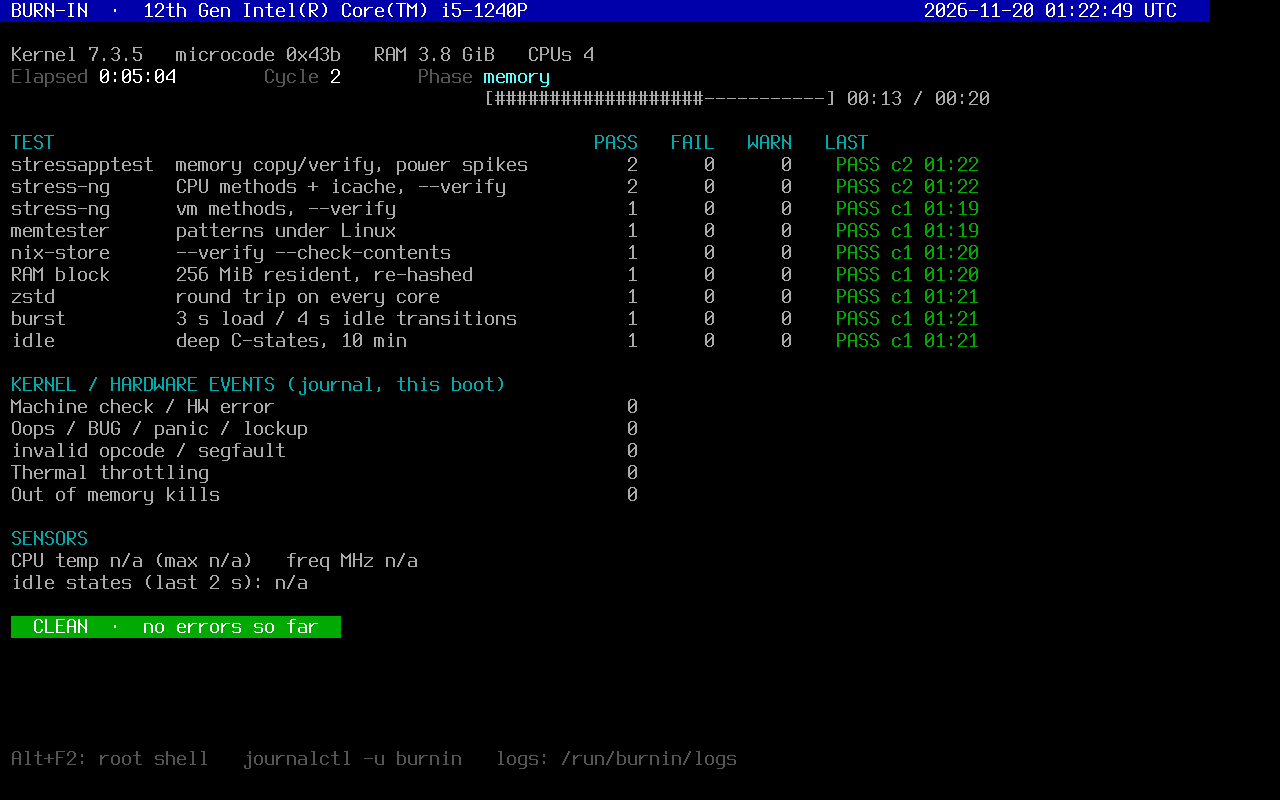
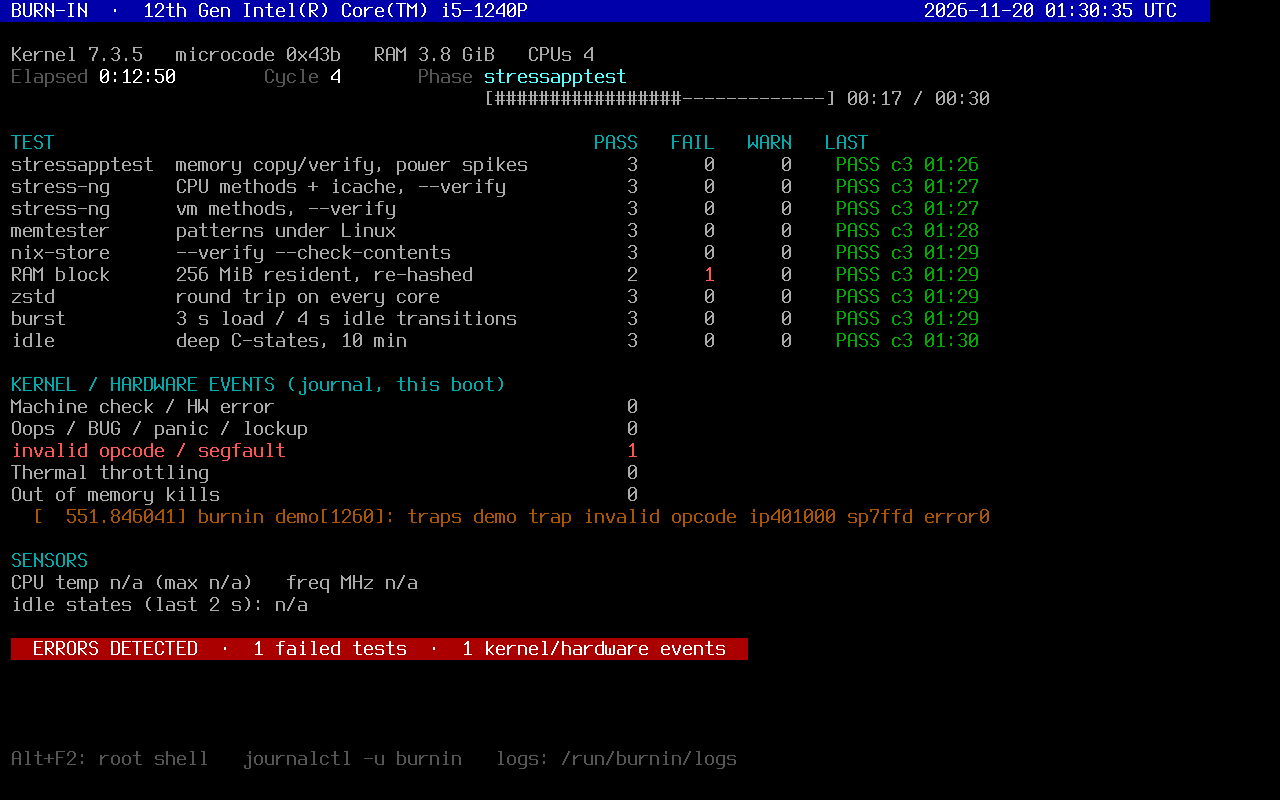
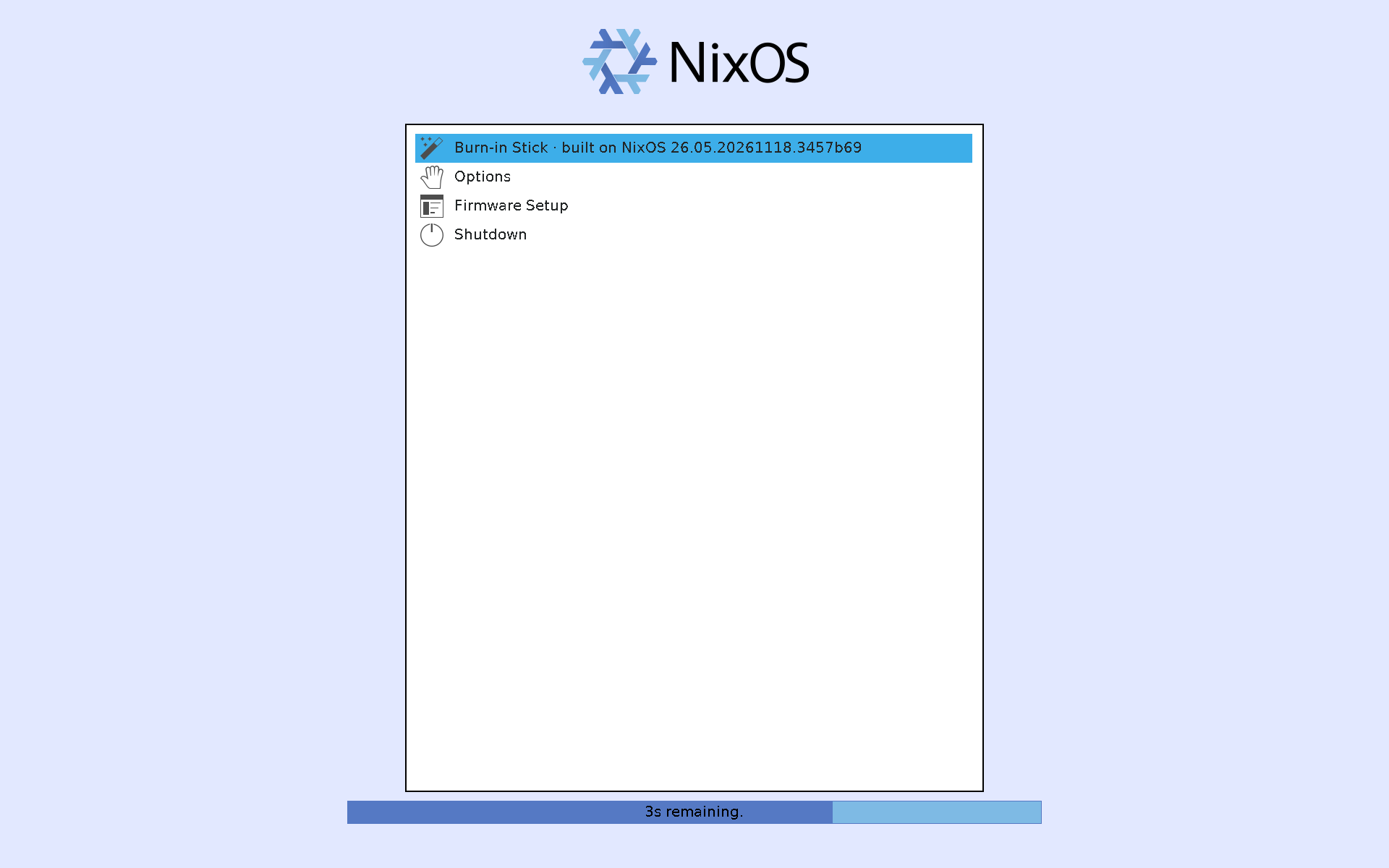
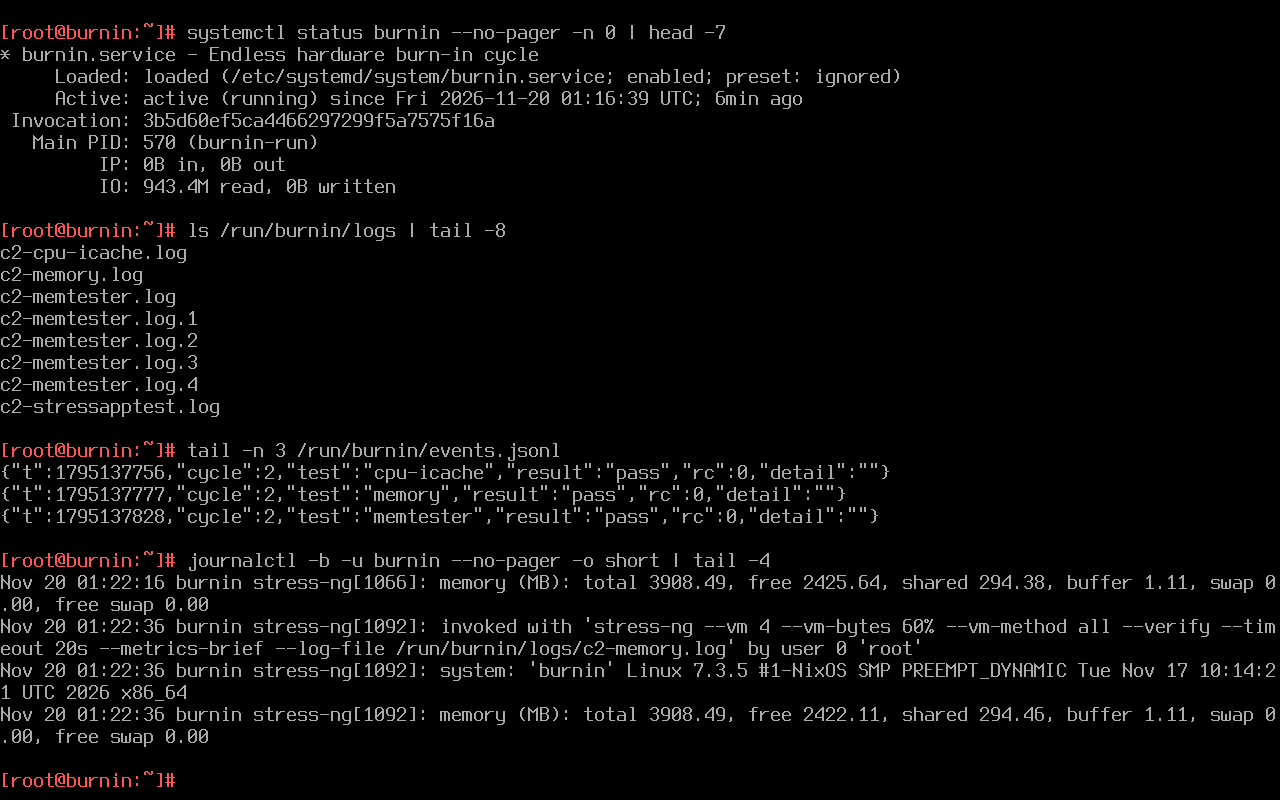
journalctl -u burnin, per-phase logs in /run/burnin/logs/, turbostat, sensors.03one cycle · ~75 min · forever
| phase | command | catches |
|---|---|---|
| stressapptest · 15 min | stressapptest -s 900 -M <70% free> -m <cores> -W --cc_test --pause_delay 120 --pause_duration 15 |
bit flips under heavy copy load (Google's server burn-in), cache coherency across cores, a 15 s drop to idle every 2 min |
| cpu-icache · 10 min | stress-ng --cpu 0 --cpu-method all --icache <cores> --verify |
wrong arithmetic results, instruction-cache reload faults |
| memory · 10 min | stress-ng --vm <cores> --vm-bytes 60% --vm-method all --verify |
memory pattern errors with Linux paging and caching active |
| memtester · ≤ 25 min | memtester <½ free / cores>M 1 on every core in parallel |
the classic patterns (stuck address, walking bits, …), this time under the real kernel |
| integrity | nix-store --verify --check-contents · sha256sum of a 256 MiB block held in RAM · zstd | zstd -d | sha256sum per core |
flips in program bytes cached in RAM (fine on disk, wrong in memory) and in data that has been resident for hours |
| burst · 10 min | loop: stress-ng --cpu 0 --verify -t 3s; sleep 4 |
hundreds of P-state and C-state transitions, the conditions memtest never creates |
| idle · 10 min | sleep 600 |
deep package C-states, like a server at 4 a.m. |
verdicts
- PASS: the tool exited cleanly and found no verification error.
- FAIL: a verification error, stressapptest
Status: FAIL, memtester error bits0x02/0x04, or stress-ng exit2(stressor failed),5(killed by a signal),6or7(corrupted counters). - WARN: a harness or resource problem, such as stress-ng exit
1/3/4or a memtester allocation failure. Not a verdict by itself. Read the log. - Each flip counts once. When the resident block changes, the change is recorded and the new content becomes the reference, just as memtest reports an address once and moves on.
04what the screen listens for
Every 6 s the status screen reads the journal of the current boot incrementally (journalctl --after-cursor)
and sorts new lines into five classes. Lines written by the test tools themselves are skipped; their
failures are already counted as test results.
| class | severity | pattern |
|---|---|---|
| Machine check / HW error | error | Machine check|Hardware Error|EDAC|mce: \[ |
| Oops / BUG / panic / lockup | error | Oops|BUG:|general protection fault|Kernel panic|soft lockup|hard LOCKUP|rcu_\w+ (self-)?detected stall|WARNING: CPU |
| invalid opcode / segfault | error | invalid opcode|segfault at|traps:|dumped core|SIGILL|SIGSEGV|SIGBUS |
| Thermal throttling | warn | temperature above threshold|clock throttled |
| Out of memory kills | warn | Out of memory|oom-kill |
temperature
Maximum of coretemp / k10temp hwmon inputs (falling back to thermal zones), with the session maximum next to it.
frequency
scaling_cur_freq of every core, sampled every 2 s. In the burst phase you can watch the numbers jump.
idle states
Deltas of cpuidle/state*/time summed over all cores: the share of wall time spent in POLL, C1, C6, C10 … during the last 2 s. It proves the idle phase really goes deep.
05internals
decisions worth stealing
consoleblank=0andkernel.panic=0. After 40 hours you want to read the panic, not stare at a blank screen or a box that silently rebooted.- The status screen is a systemd unit on tty1 (
TTYPath=/dev/tty1,StandardInput=tty-force,Restart=always,Nice=-5,OOMScoreAdjust=-900) instead of an autologin shell script. The test eats RAM on purpose (OOMScoreAdjust=500); the screen must survive it. It forces a full repaint every 30 s, so kernel messages that scribble over the screen cannot hide state for long. A panic stays, because nothing repaints any more. - No network at all. A burn-in candidate is often a router or a box whose MAC addresses another machine is using right now. A stick that runs DHCP would be a second router on the LAN.
- The internal disks stay untouched. Nothing is mounted. stressapptest runs without
-d/-f, the RAM block lives on the root tmpfs, and the logs go to/run. - Store verification as a memory test. After the first pass the whole Nix store sits in the page cache. Re-hashing it every cycle checks hundreds of MB of executable bytes that have been resident for hours. That is the failure class where the bytes are fine on disk but wrong when executed.
- One JSON line per result, written with
jq -cn --arg, so no hand-rolled quoting. The counters are derived from the log rather than kept in memory, so a restarted service (Restart=on-failure) continues the cycle count instead of resetting it. - The same kernel the box will run.
linuxPackages_latestplus Intel and AMD microcode, the way a typical NixOS host boots. A bug that only shows with that kernel's power management is a real bug. - Built as a flake package, not a host.
packages.x86_64-linux.isoplusnixosModules.default, so you can bake the burn-in into an image of your own.
06build · hack · embed
build
$ git clone https://github.com/devfbe/burnin-stick $ cd burnin-stick $ nix build .#iso # → result/iso/burnin-stick.iso
a full cycle in minutes
# divide every phase duration by 60
systemd.services.burnin.environment.BURNIN_SCALE = "60";
embed in your own image
{
inputs.burnin-stick.url = "github:devfbe/burnin-stick";
outputs = { nixpkgs, burnin-stick, ... }: {
nixosConfigurations.my-burnin = nixpkgs.lib.nixosSystem {
modules = [
burnin-stick.nixosModules.default
{ nixpkgs.hostPlatform = "x86_64-linux"; }
];
};
};
}
files
flake.nix outputsburnin.nix the imageburnin-run.sh the cycledashboard.py the screen
not included
mprime: its source fetch in nixpkgs 26.05 is broken upstream. y-cruncher: needs AVX, which many low-power boxes do not have.
safety & license
Root has no password, on the local console only. The box gets hot, which is the point. MIT for the repo code; the ISO is free software plus redistributable CPU microcode, and the source is the flake. No warranty.